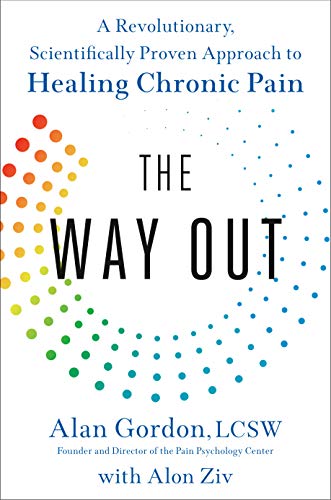
The method behind this book
- Tested in JAMA Psychiatry, 2022
- University of Colorado Boulder trial
- 66% pain-free or nearly so in 4 weeks
You read The Way Out. So why does the pain keep winning?
You read Alan Gordon's The Way Out. Maybe you tried somatic tracking from the book, sat with the sensation, told your brain it was safe. Some days it helped. Then it stalled, and the old thought crept back in. Maybe this one won't work either.
That stall isn't a sign the method is wrong. It's the most common place people get stuck, and there's a reason for it.
Your pain is real. Neuroplastic pain doesn't mean imaginary. It means your brain learned a danger signal and kept firing it after the danger passed. Pain reprocessing therapy, the approach the book is built on, teaches your brain that the signal is safe. The technique is sound. Doing it alone, once in a while, while quietly watching to see if the pain drops, is usually why it stops working.
What The Way Out actually teaches
Gordon's idea is simple. Chronic pain is often a false alarm. The brain's danger system gets stuck on, and fear keeps it there. Pain sparks fear, fear tells the brain there's a threat, and the brain makes more pain. He calls it the pain-fear cycle.
The answer isn't to fight the pain. It's to teach the brain it's safe, using a technique called somatic tracking. You turn your attention toward the sensation, but through a lens of calm and curiosity instead of alarm. Over enough of these moments, the brain starts to file the signal as safe, and the alarm quiets down.
The catch is in two small words the book keeps repeating: outcome independence. You're not watching the pain to make it go away. The moment you're secretly hoping it drops, you've told your brain the pain still matters, and the alarm stays on.
66%
Pain-free or nearly pain-free after four weeks of the approach behind the book, with brain scans showing the change.
Ashar, Gordon, et al., JAMA Psychiatry, 2022 (the University of Colorado Boulder study). DOI: 10.1001/jamapsychiatry.2021.2669
This trial was specific to chronic back pain. It's the study The Way Out is built on, and the relief held up over time.
A quick gut check
Does your pain move around, or flare up with stress?
See if your pain fits the patternMarcus41 · low back pain · 6 yearsComposite story, drawn from documented cases. Not a real named person.
Marcus read the book in a weekend and felt seen on every page. He tried somatic tracking that night. His back pain softened a little, and he thought, this is it. For two weeks it worked on and off.
Then it stopped. He kept doing the exercise, but every time, in the back of his mind, he was checking. Did it drop? Is it gone yet? Without meaning to, he'd turned the technique into one more way of chasing relief, and his brain heard the message loud and clear: this pain is still a problem. The method wasn't failing him. He just had no one to catch the one habit that was quietly undoing it.
Composite story based on common patient experiences. Not a specific individual.
How to do somatic tracking, the core technique
Here's the short version you can try right now. For the full walk-through, see our somatic tracking guide. One round won't do much. Steady, gentle practice is what teaches the brain safety over weeks.
Two minutes, where you are
A two-minute somatic tracking exercise
Don't take our word for it. This is one rep of the practice the book describes, with a quick read before and after, so you feel what it does. It's gentle, and you can stop anytime.
- 1Pick a moment when the pain is low or medium, not a full flare. High pain is the wrong time to practice.
- 2Turn your attention toward the sensation. Don't brace against it. Just notice where it is and what it's like. Warm, tight, buzzing, dull?
- 3Bring curiosity instead of fear. You're a reporter, not a firefighter. Quietly remind your brain: this is a safe signal, my body is okay.
- 4Stay outcome independent. If it moves, softens, or does nothing, that's all fine. You're not here to make it stop. You're here to show your brain there's nothing to defend against.
You're further along than you think
- Understand itYou read the book
- Feel itOne rep, done above
- Practice dailyWhere most people stall
- RecoverThe pattern fades
What to do when somatic tracking isn't working
If you've tried it and the pain won't budge, you're in good company, and it's almost never because the method is wrong for you. Three things stall it.
First, you're chasing relief. If part of you is checking whether the pain dropped, you're not outcome independent, and the brain keeps the alarm on. This is the big one.
Second, you're practicing too rarely. A pattern your brain ran for years needs steady reps, not a session here and there when the pain spikes.
Third, you're practicing at high pain. Somatic tracking works best at low to medium sensation. In a flare, the job is comfort and safety, not tracking.
The hard part is that these are tough to catch in yourself. Most people can't see they're quietly chasing relief, because it feels like just doing the exercise. That's the gap a book can't close on its own.
| What matters | The Way Out on its own |  The Way Out + PainAppYour next step The Way Out + PainAppYour next step |
|---|---|---|
| The science | Clear and warm. The Boulder study is real. | The same science, in two-minute daily pieces. |
| Doing the practice | You read how. Then you're on your own. | Guides each rep, so you actually do it. |
| When you stall | No one to catch the relief-chasing that stalls you. | Spots the outcome-independence trap the moment it happens. |
| Sticking with it | Easy to drift by week two. | A gentle daily nudge, so it doesn't fade. |
| When pain flares | No plan for the bad days. | A flare plan, ready the moment you need it. |
| Your pain coach | The page can't answer back. | A Pain Coach answers your questions, day or night. |
| Pain tracking | No way to tell if it's helping. | Pain tracking, with tailored feedback. |
| Kept up to date | Frozen at publication. | The latest pain neuroscience education, updated as the research moves. |
The Way Out + PainApp
Your next step
The science
The Way Out on its own: Clear and warm. The Boulder study is real.
PainApp: The same science, in two-minute daily pieces.
Doing the practice
The Way Out on its own: You read how. Then you're on your own.
PainApp: Guides each rep, so you actually do it.
When you stall
The Way Out on its own: No one to catch the relief-chasing that stalls you.
PainApp: Spots the outcome-independence trap the moment it happens.
Sticking with it
The Way Out on its own: Easy to drift by week two.
PainApp: A gentle daily nudge, so it doesn't fade.
When pain flares
The Way Out on its own: No plan for the bad days.
PainApp: A flare plan, ready the moment you need it.
Your pain coach
The Way Out on its own: The page can't answer back.
PainApp: A Pain Coach answers your questions, day or night.
Pain tracking
The Way Out on its own: No way to tell if it's helping.
PainApp: Pain tracking, with tailored feedback.
Kept up to date
The Way Out on its own: Frozen at publication.
PainApp: The latest pain neuroscience education, updated as the research moves.
A 2-minute check. Start there.
Is The Way Out enough on its own?
For some people, yes. For a lot of people, the book opens the door and then they stall on the one thing it can't watch for: are you doing this to feel safe, or to make the pain stop?
That's the part we built PainApp to do. The Pain Coach answers the 11pm question the book can't, the am I doing this right that sends so many people in circles. The guided sessions walk you through somatic tracking instead of leaving you to read a transcript and guess. The pain tracker watches for the brain patterns, not just how much it hurts, so you can see progress without chasing it, which is the outcome-independence trap solved by design.
Same method as the book. It just doesn't leave you to spot your own blind spot.
Real people, real recoveries
Could your pain be neuroplastic?
Your pain is real. Take a free 2-minute test to understand your pain patterns and explore your next step.
Take the free pain testSee your result straight away.
A note on the person behind the book
Alan Gordon, LCSW
Alan Gordon is a psychotherapist and the founder of the Pain Psychology Center in Los Angeles, one of the largest clinics focused on chronic pain. He's also an adjunct assistant professor at the University of Southern California. He developed Pain Reprocessing Therapy after living through years of his own chronic pain in graduate school, then helped run the Boulder study that put the approach to the test. He wrote The Way Out with Alon Ziv.
See the Pain Psychology Center
We are not affiliated with Alan Gordon, and he has not endorsed this app. We point to his work because the research is solid and the method is sound.
Could your pain be neuroplastic?
Your pain is real. Take a free 2-minute test to understand your pain patterns and explore your next step.
Take the free pain testSee your result straight away.
Already read the book and ready to go?
Or just start the app
Read the book and ready to keep going? You can skip ahead. PainApp is on iPhone and Android.


Founder, PainApp
Researching neuroplastic pain science and recovery methods for 3+ years.
Frequently Asked Questions
For most people in neuroplastic pain, yes. It's a clear, warm explanation of pain reprocessing therapy and somatic tracking, backed by the Boulder study. Where people get stuck is doing the technique consistently and staying outcome independent, which the book can't watch for.
Usually one of three things. You're quietly chasing relief instead of staying outcome independent, you're practicing too rarely, or you're practicing during a full flare. The technique is rarely the problem. The mindset and the consistency usually are.
It means practicing somatic tracking without trying to make the pain go away. The moment part of you is checking whether it dropped, you've signaled to your brain that the pain still matters, and the danger alarm stays on. It's the hardest part to get right.
It varies. In the Boulder study, most back-pain patients improved within about four weeks. Gordon's own answer is that it takes as long as it takes your nervous system to learn safety. Steady practice matters more than speed.
They share roots. Gordon helped shape the ideas behind both. They take different forms, though, and fit different people. We compare the options on our Curable alternative page if you want the side by side.
No. Keep working with your clinician, especially to rule out anything structural first. This approach sits alongside medical care, not instead of it.
Keep reading
Somatic Tracking, Step by Step
The full walk-through of the core technique.
Pain Reprocessing Therapy (PRT)
The approach The Way Out is built on, validated in JAMA Psychiatry.
Neuroplastic Pain: Symptoms and Causes
Why the brain keeps the alarm on, and why it's reversible.
Back Pain and the Brain
The condition the Boulder study focused on.
Healing Back Pain (Sarno)
The book that started the field, and why belief alone often isn't enough.
PainApp vs Curable
How the app options compare, side by side.
Pain Free You (Buglio)
Another route to the same goal: teaching the brain it's safe.
References
- Ashar YK, Gordon A, Schubiner H, et al. Effect of Pain Reprocessing Therapy vs Placebo and Usual Care for Patients With Chronic Back Pain: A Randomized Clinical Trial. JAMA Psychiatry, 2022;79(1):13-23. PubMed
Medical Disclaimer: This content is for informational purposes only and does not constitute medical advice, diagnosis, or treatment. Always consult with a qualified healthcare provider about your specific condition. Pain is real regardless of its source. Neuroplastic pain is a legitimate medical phenomenon, not a suggestion that pain is imaginary. If you are in crisis, contact FindAHelpline.com for immediate support.