The science behind the safety message
- Tested in JAMA Psychiatry, 2022
- University of Colorado Boulder trial
- 66% pain-free or nearly so in 4 weeks
You know you're supposed to feel safe. So why don't you?
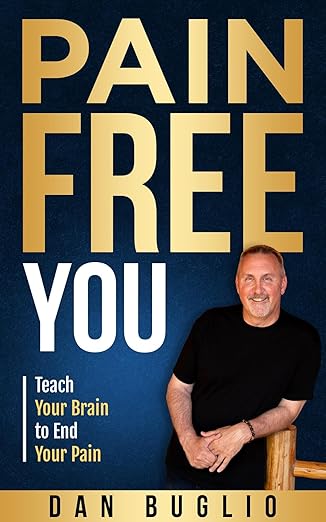
You've watched Dan Buglio's videos. Maybe a lot of them. You read Pain Free You. You get the message, your brain is making real pain out of a false sense of danger, and the way out is to teach it you're safe.
And you still don't feel safe. The pain's still here. So you do what everyone does. You decide you must be missing something, and you go looking for the next video, the next tip, the missing piece.
Here's the thing. You're probably not missing a piece. Feeling safe sounds simple, and the idea is. Actually doing it, in your body, on a hard day, for your specific pain, is the part nobody can hand you in a video. Your pain is real. Neuroplastic pain doesn't mean imaginary. And the safety message is right. The gap is in the doing.
What Pain Free You teaches
Dan's idea is refreshingly plain. Your brain has one job, keep you safe. When it decides your body is in danger, even when it isn't, it can turn on real pain to get your attention. The tissue can mend and the alarm can still stay on, because the brain still reads the situation as dangerous.
So the fix isn't another treatment. It's convincing your brain there's no threat. You do that by responding to pain calmly instead of with fear, by living your normal life instead of guarding against the pain, and by dropping the constant search for a fix, because the searching itself tells your brain something is still wrong.
Dan got here the hard way. He understood Sarno's ideas for years and stayed in pain, because the advice was vague. Think psychologically. Talk to your brain. What does that even mean? His whole project was making it simpler. The message is as simple as it gets. Living it is the part that still takes work.
66%
Pain-free or nearly pain-free after four weeks of an approach built on teaching the brain safety, with brain scans showing the change.
Ashar, Gordon, Schubiner et al., JAMA Psychiatry, 2022 (the Boulder study). DOI: 10.1001/jamapsychiatry.2021.2669
The study was specific to chronic back pain, the same pain Dan recovered from. Safety reappraisal, teaching the brain a signal is safe, is the mechanism it tested.
A quick gut check
Does your pain move around, or flare up with stress?
See if your pain fits the patternBen44 · chronic back pain · 8 yearsComposite story, drawn from documented cases. Not a real named person.
Ben found Dan's channel and watched a video every morning for months. He loved them. He could recite the message: you're not broken, it's safe, stop chasing the fix. He believed every word.
But on the bad days, knowing he was safe and feeling safe were two different planets. He'd tell himself it's fine and his body wouldn't buy it. So he did the only thing that made sense, he watched more videos, looking for the angle he'd missed. He wasn't missing an angle. He had the message cold. What he didn't have was a way to practice feeling safe, on purpose, in small daily reps tuned to his own pain, instead of hoping the next video would flip a switch.
Composite story based on common patient experiences. Not a specific individual.
How to actually send your brain safety
Here's a short version of the practice the message points at. Two minutes. One round won't change much. Done daily, calmly, this is how safety stops being a slogan and starts being something your nervous system learns.
Two minutes, where you are
A two-minute safety practice
Don't take our word for it. This is one rep of the practice the book describes, with a quick read before and after, so you feel what it does. It's gentle, and you can stop anytime.
- 1Notice the sensation without alarm. Don't fight it, don't measure it. Just let it be there for a moment.
- 2Tell your brain the truth, and mean it. My body is not broken. This is a danger signal, not damage. I am safe right now.
- 3Do one ordinary thing you've been guarding against, gently. Sit, stand, reach, walk a little. Proof of safety beats a pep talk.
- 4Drop the checking. Don't scan to see if the pain dropped. Feeling safe isn't a result you chase. The chasing is the thing that keeps the alarm on.
You're further along than you think
- Understand itYou read the book
- Feel itOne rep, done above
- Practice dailyWhere most people stall
- RecoverThe pattern fades
Why 'just feel safe' is harder than it sounds
Telling someone in pain to feel safe is a bit like telling someone who can't sleep to relax. The instruction is correct. It's also not a step you can actually follow, not when your body is sounding an alarm and a calm thought won't override it.
Three things trip people up. They treat safety as a thought instead of a felt experience built through reps. They practice only when the pain spikes, when it's hardest, instead of daily when it's easier. And they keep secretly checking whether it worked, which is just chasing the fix in a quieter outfit.
The daily videos are really good at keeping the message alive. What they can't do is stand next to you and turn the message into a practice that fits your day and your pain. That's the gap a stream of videos leaves open.
| What matters | Pain Free You on its own |  Pain Free You + PainAppYour next step Pain Free You + PainAppYour next step |
|---|---|---|
| The message | Clear, simple, repeated daily, and good. | The same message, turned into a daily practice. |
| Doing it | Watch and absorb. | A guided practice, step by step. |
| When you stall | Watch another video, hoping for the missing piece. | Catches the relief-chasing that keeps the alarm on. |
| When pain flares | Find another video. | A flare plan, ready the moment you need it. |
| Your pain coach | A video can't answer back. | A Pain Coach answers your questions, day or night. |
| Pain tracking | You wonder if it's working. | Pain tracking, with tailored feedback. |
| Kept up to date | Frozen at publication. | The latest pain neuroscience education, updated as the research moves. |
| Fit to your pain | One message for everyone. | Tuned to the chronic pain you actually have. |
Pain Free You + PainApp
Your next step
The message
Pain Free You on its own: Clear, simple, repeated daily, and good.
PainApp: The same message, turned into a daily practice.
Doing it
Pain Free You on its own: Watch and absorb.
PainApp: A guided practice, step by step.
When you stall
Pain Free You on its own: Watch another video, hoping for the missing piece.
PainApp: Catches the relief-chasing that keeps the alarm on.
When pain flares
Pain Free You on its own: Find another video.
PainApp: A flare plan, ready the moment you need it.
Your pain coach
Pain Free You on its own: A video can't answer back.
PainApp: A Pain Coach answers your questions, day or night.
Pain tracking
Pain Free You on its own: You wonder if it's working.
PainApp: Pain tracking, with tailored feedback.
Kept up to date
Pain Free You on its own: Frozen at publication.
PainApp: The latest pain neuroscience education, updated as the research moves.
Fit to your pain
Pain Free You on its own: One message for everyone.
PainApp: Tuned to the chronic pain you actually have.
A 2-minute check. Start there.
Is watching the videos enough?
For some people, honestly, yes. If the daily videos got you there, that's wonderful, and you may not need anything else.
For everyone who has the message memorized and still hurts, the missing piece is turning feel safe into a daily practice you can actually follow. That's what we built PainApp to do. The guided sessions walk you through sending your brain safety instead of leaving you to figure out what that means. The pain tracker watches for the patterns changing, so you stop wondering whether it's working and start seeing it. And it's tuned to your condition, not one message for everyone.
Same idea Dan teaches. It just gives feeling safe a shape you can practice.
Real people, real recoveries
Could your pain be neuroplastic?
Your pain is real. Take a free 2-minute test to understand your pain patterns and explore your next step.
Take the free pain testSee your result straight away.
A note on the person behind the book
Dan Buglio
Dan Buglio is an author and pain recovery coach, not a physician. He spent thirteen years in chronic back pain and sciatica before recovering, and has spent years since teaching a mind-body approach centered on safety. He's best known for posting a short video every single day since 2019, building a large following, and his book Pain Free You puts that daily message into one place.
We are not affiliated with Dan Buglio, and he has not endorsed this app. We point to his work because the safety message is sound and matches the science. Dan is a coach, not a doctor, so we ground the research here in published trials, not in his authority.
Could your pain be neuroplastic?
Your pain is real. Take a free 2-minute test to understand your pain patterns and explore your next step.
Take the free pain testSee your result straight away.
Already read the book and ready to go?
Or just start the app
Got the message and ready to practice it? You can skip ahead. PainApp is on iPhone and Android.


Founder, PainApp
Researching neuroplastic pain science and recovery methods for 3+ years.
Frequently Asked Questions
It's a mind-body approach built on one idea: chronic pain is your brain's danger signal, and you reverse it by teaching your brain it's safe. In practice that means responding to pain calmly, living your normal life instead of guarding, and dropping the constant search for a fix.
Usually because you have the message but not the practice. Feeling safe sounds simple, but it's a felt skill built through daily reps, not a thought you can flip on. Watching more videos rarely closes that gap. A structured daily practice tuned to your pain usually does more.
It means giving your nervous system repeated, believable evidence that you're not in danger. Calm responses to pain, normal movement instead of guarding, and letting go of the urgent search for relief. Over enough reps, the brain stops treating the signal as a threat and the pain settles.
It comes from the same lineage. Dan struggled with Sarno's ideas for years because they felt vague, and built his work to be simpler and more repeatable. He leans on present-day safety more than digging into past emotions. We cover Sarno's TMS framework separately.
If you like a simple, encouraging, no-jargon take on mind-body recovery, yes. It gathers Dan's daily message into one book. Just know it's strong on the message and lighter on a structured, personalized plan for actually practicing it.
No. Keep working with your clinician, especially to rule out anything structural first. This approach sits alongside medical care, not instead of it.
Keep reading
Neuroplastic Pain: Symptoms and Causes
Why the brain keeps the alarm on, and why it's reversible.
Pain Reprocessing Therapy (PRT)
The safety-based approach, validated in JAMA Psychiatry.
Somatic Tracking, Step by Step
A core way to send your brain safety, in full.
Central Sensitization
The mechanism that turns a safe signal into chronic pain.
Back Pain and the Brain
The pain Dan recovered from, explained.
How Marcus Recovered From Back Pain
A recovery story that matches the approach.
References
- Ashar YK, Gordon A, Schubiner H, et al. Effect of Pain Reprocessing Therapy vs Placebo and Usual Care for Patients With Chronic Back Pain: A Randomized Clinical Trial. JAMA Psychiatry. 2022;79(1):13-23. PubMed
Medical Disclaimer: This content is for informational purposes only and does not constitute medical advice, diagnosis, or treatment. Always consult with a qualified healthcare provider about your specific condition. Pain is real regardless of its source. Neuroplastic pain is a legitimate medical phenomenon, not a suggestion that pain is imaginary. If you are in crisis, contact FindAHelpline.com for immediate support.