
Could Your Pain Be Neuroplastic?
Your pain is real. Take a 2-minute test to discover whether your symptoms show signs of neuroplastic pain and what this could mean for your recovery.
Understand Your Pain Patterns
Answer a few simple questions about your symptoms. Get personalized insights in just 2 minutes, including whether medical evaluation may be important.
Flagship Chronic Pain Management Solutions
Crafted with love by individuals who understand your journey.
It all starts with accurate knowledge
Rewire your brain
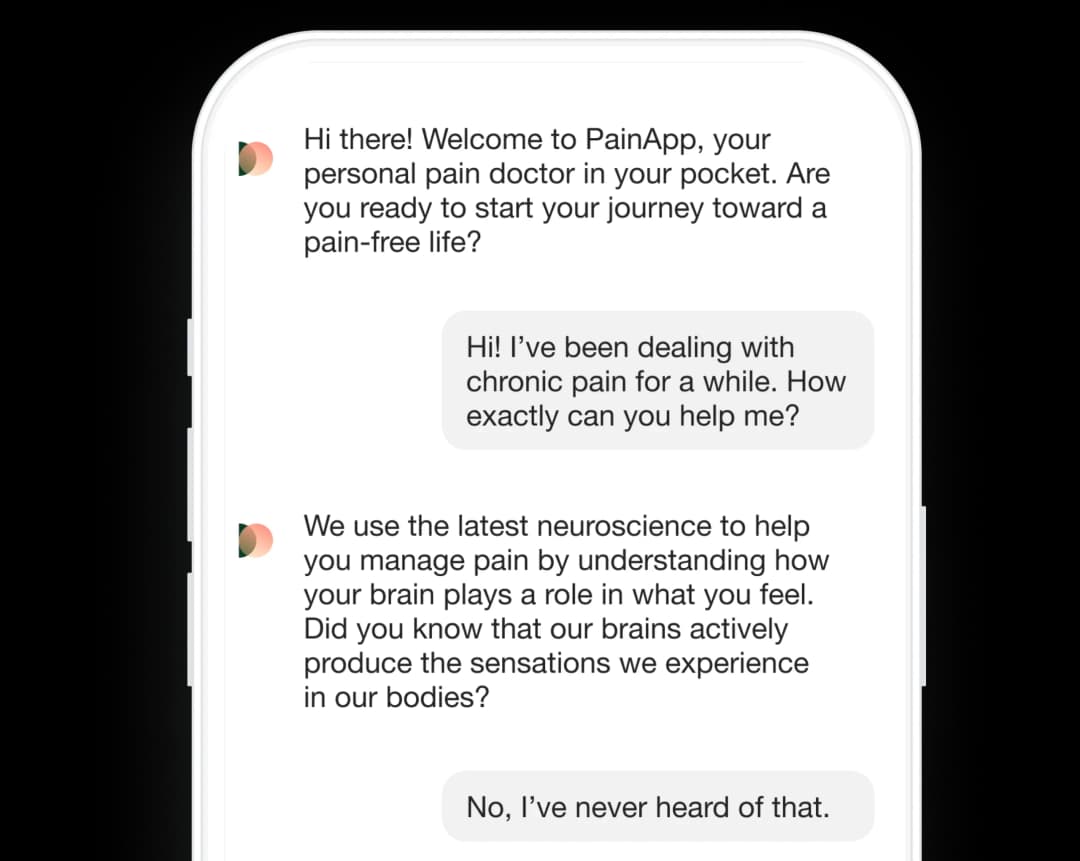
Emerging neuroscience shows that our brains actively produce the sensations we feel in our bodies. Consider “phantom limb syndrome,” in which amputees continue to feel very real pain in limbs no longer there.
Knowledge Is Medicine.
Break Your Pain Cycle
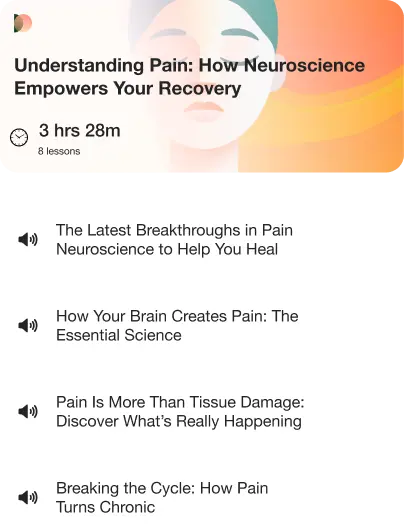
It may sound surprising, but it’s true: learning about pain is one of the most effective treatments available. This approach, called Therapeutic Neuroscience Education, helps you understand how pain works in your brain and body, and how to break free from the cycle of chronic pain.
Your pain coach
Anytime, Anywhere
Pain isn’t just physical. It’s personal. That’s why PainApp gives you a pain coach to help you navigate and reduce chronic pain using neuroscience-based strategies. With guidance, relief is always within reach.
Build a better you
Pain tracking
Track your pain, discover insights, and receive personalized safety messages to improve your well-being. Our app empowers you to take control of your chronic pain by identifying patterns, triggers, and effective management strategies.

About your pain test
What it can tell you, how it works, and what comes next.
Explore our full research library.
What can this test tell me?
It looks for patterns in how your pain behaves, then explains what your answers may mean and which next step to consider. It's a starting point for understanding your pain, not a diagnosis.
Can I take it for my type of pain?
Yes. You can use it to explore patterns in back or neck pain, fibromyalgia, migraines, TMJ, IBS and other persistent symptoms. The questions look at how pain behaves rather than one body part.
Is neuroplastic pain still real pain?
Yes. Your pain is real, and it isn't your fault. Neuroplastic pain describes changes in how the nervous system processes pain signals. That sensitivity can also exist alongside an injury or another medical condition.
What happens after I get my result?
You'll get an explanation and a next step. If PainApp fits, you can talk things through with your pain coach, follow neuroscience lessons and track your pain on the web, iPhone or Android. If you need medical care first, your result will say so.
When should I see a doctor first?
Some symptoms need medical attention, sometimes urgently. That's why safety questions come first. If your answers raise a concern, the test stops and explains what to do next. Please follow that guidance before starting a pain program.
Are my answers saved or shared?
Your answers and result stay in your browser. They aren't uploaded or saved, and refreshing or closing the page clears them. If you allow analytics, we count basic steps, such as starting or finishing. Those events never include your answers or result.
Is the test free?
The test is free. PainApp is optional: $29.99 every 3 months in the US, with a 3-day free trial for eligible new subscribers, or $9.99 per week without a trial. Cancel before your next renewal. Your checkout or app store confirms the final price and terms.
How was this test put together?
Two safety checks come first, followed by ten questions about your symptoms and how your pain behaves. The result highlights patterns to explore with your healthcare team.
This is an educational self-check, not a clinically validated diagnostic test. The studies below explain the background science; they don’t validate this questionnaire or predict your individual outcome.
Selected background studies
- Pain Reprocessing Therapy for chronic back pain
Ashar et al. · JAMA Psychiatry, 2022
- Spinal imaging findings in people without pain
Brinjikji et al. · AJNR, 2015
- Emotional Awareness and Expression Therapy for older veterans with chronic pain
Yarns et al. · JAMA Network Open, 2024
More studies, organized by condition, with links to the original research.
Every question, explained
Are you experiencing any of these right now?
A few symptoms point to causes that need a doctor today. If you tick one, the test stops here.
Do any of these apply to you?
These are reasons for a doctor to check things first, before any pain program.
Have you seen a doctor about your pain, and were serious causes ruled out?
Ruling out other causes comes first. A clean scan, or a finding that doesn’t match how much it hurts, is a strong clue.
How long have you had these symptoms?
Most tissue heals within about 3 months. Pain that stays longer is often a signal the nervous system kept sending.
What happens to the location of your pain?
Damage stays in one place. Pain that moves or spreads follows the nervous system.
What makes your symptoms worse?
Pain that responds to stress or expectation, rather than load, is being turned up by the nervous system.
When you’re distracted, having fun, or on vacation, what happens to your pain?
Damaged tissue doesn’t take a day off. A nervous system on alert can stand down when attention moves.
Which best describes your pain pattern?
Big swings, or pain that tracks your stress more than your activity, point to the nervous system.
How many of these other symptoms do you have, or have you had?
Conditions like IBS, migraines and TMJ often show up together, which research links to a sensitized nervous system.
Which of these personality traits sound like you?
Constant inner pressure keeps the nervous system on guard. It isn’t a flaw, and it isn’t the cause on its own.
Did your pain start or get worse after any of these?
Pain that began in a hard stretch of life, or outlasted a healed injury, is a classic sign of a learned alarm.
Last one. How much does fear of movement or re-injury affect your daily life?
Fear tells the nervous system there’s danger, which turns pain up. It’s also one of the most changeable parts.
This test is for education and doesn’t replace medical care. Keep working with a qualified healthcare professional, and follow any guidance to seek medical evaluation.
Updated