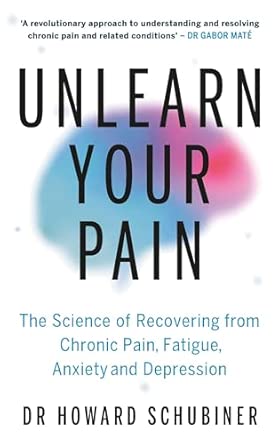
You finished the 28 days
The writing helped. Some mornings the pain backed off and you thought, okay, maybe this is real. Then the workbook ended. And your nervous system didn't get the memo.
If your pain crept back after you closed the book, you didn't do it wrong. You ran a 28-day program for a brain pattern that took years to build. The pattern needs more reps than a month can give it.
Your pain is real. Neuroplastic doesn't mean imaginary. It means your brain learned the pain, the way it learned to read or ride a bike. And the same brain that learned it can learn its way back out. Here's the part most people miss. The fact that the program moved your pain at all is the proof. A pattern that can move is a pattern that can keep moving. You didn't lose the method. You lost the daily reps.
What the book actually teaches
Dr. Schubiner calls it Mind Body Syndrome. The name matters less than the idea.
Pain is an alarm. Most of the time it's useful. You touch a hot stove, the alarm fires, you pull your hand back. But an alarm can get stuck on. It can keep firing long after the danger is gone, because the brain learned the pattern and now runs it on autopilot. The tissue healed. The alarm didn't switch off.
The book's answer isn't to fight the pain. It's to teach your brain it's safe. You write, to let buried feelings move instead of sitting in the body. You talk to your brain, in plain calm language. And you sit with sensation without panic, so the alarm slowly learns it doesn't need to keep ringing. That's the work. It's repetition, the same way you'd retrain any habit.
2x
About twice as many people cut their pain in half compared with standard cognitive behavioral therapy.
Lumley and Schubiner et al., PAIN, 2017
A trial of 230 people with fibromyalgia, using the emotion-focused approach Schubiner co-developed. In it, 22.5% of EAET patients cut their pain at least in half, versus 8.3% with CBT (Lumley and Schubiner et al., Pain, 2017).
Dana38 · pelvic pain · 3 yearsComposite story, drawn from documented cases. Not a real named person.
Dana read the book in a week and did the program in a month. Every scan came back clean, which somehow made it worse, because clean scans felt like nobody believed her. The writing cracked something open around week two. She wrote a letter she never sent and cried for an hour and her pain dropped for two days straight.
Then day 28 came. The structure stopped. Within a few weeks the old pattern was back, and so was the thought she hated most: maybe this was always going to fail too. It wasn't failing. She'd proven the method moved her pain. What she'd lost was the daily reps. The book gave her the engine. It just didn't give her the road to keep driving on.
Composite story based on common patient experiences. Not a specific individual.
66%
Pain-free or nearly pain-free after four weeks, with brain scans showing the change.
Ashar, Schubiner et al., JAMA Psychiatry, 2022. DOI: 10.1001/jamapsychiatry.2021.2669
Schubiner was a co-investigator. This trial was specific to chronic back pain, so treat it as one example, not the headline number for every condition.
Try the core move for two minutes
Want to feel how this works? You can read the steps below and try it right now, no app needed. One round won't do much. A round a day for weeks is what starts to retrain the pattern. That's the part a book can't stand over your shoulder and help you keep doing.
Two minutes, where you are
A two-minute felt exercise
Don't take our word for it. This is one rep of the practice the book describes, with a quick read before and after, so you feel what it does. It's gentle, and you can stop anytime.
- 1Find the pain. Don't brace against it. Just notice where it is.
- 2Get curious instead of scared. Ask, plainly, what does this actually feel like right now? Warm, tight, buzzing, dull? You're a reporter, not a firefighter.
- 3Remind your brain it's safe. Say it like you mean it. This is a learned signal. My body is okay. The scans agree with you.
- 4Notice if the sensation shifts at all. It might move, soften, or do nothing today. Any change is your brain proving the alarm isn't fixed in stone.
| What matters | Unlearn Your Pain on its own |  Unlearn Your Pain + PainAppYour next step Unlearn Your Pain + PainAppYour next step |
|---|---|---|
| The education | Excellent. Clear, evidence-based, complete. | The same science, in smaller daily pieces. |
| The 28-day program | A real structure, and useful. | Keeps going past day 28, as long as you need. |
| After the program | You're on your own. | The practice continues and adjusts to your week. |
| When pain flares back | No relapse plan in the book. | A flare plan, ready the moment you need it. |
| Fit to your condition | One program for everyone. | Tuned to the chronic pain you actually have. |
| Your pain coach | The page can't answer back. | A Pain Coach answers your questions, day or night. |
| Pain tracking | No way to tell if it's helping. | Pain tracking, with tailored feedback. |
| Kept up to date | Frozen at publication. | The latest pain neuroscience education, updated as the research moves. |
Unlearn Your Pain + PainApp
Your next step
The education
Unlearn Your Pain on its own: Excellent. Clear, evidence-based, complete.
PainApp: The same science, in smaller daily pieces.
The 28-day program
Unlearn Your Pain on its own: A real structure, and useful.
PainApp: Keeps going past day 28, as long as you need.
After the program
Unlearn Your Pain on its own: You're on your own.
PainApp: The practice continues and adjusts to your week.
When pain flares back
Unlearn Your Pain on its own: No relapse plan in the book.
PainApp: A flare plan, ready the moment you need it.
Fit to your condition
Unlearn Your Pain on its own: One program for everyone.
PainApp: Tuned to the chronic pain you actually have.
Your pain coach
Unlearn Your Pain on its own: The page can't answer back.
PainApp: A Pain Coach answers your questions, day or night.
Pain tracking
Unlearn Your Pain on its own: No way to tell if it's helping.
PainApp: Pain tracking, with tailored feedback.
Kept up to date
Unlearn Your Pain on its own: Frozen at publication.
PainApp: The latest pain neuroscience education, updated as the research moves.
A 2-minute check. Start there.
What carries the method past day 28
That's the part we built PainApp to do. The book gives you the science and a 28-day program. PainApp picks up where the book stops. Same method. It just doesn't end on day 28.
Pain Coach
Fills: the 11pm questions
Answers the questions that show up at 11pm, the ones a book can't.
The pain tracker
Fills: seeing the shift
Watches for the brain patterns, not just how much it hurts, so you can see the shift the way Dana did.
Condition courses
Fills: tuned to you
Tune the work to the pain you actually have, instead of one program for everyone.
Could your pain be neuroplastic?
Your pain is real. Take a free 2-minute test to understand your pain patterns and explore your next step.
Take the free pain testSee your result straight away.
A note on the person behind the book
Howard Schubiner, MD
Dr. Howard Schubiner is a board-certified physician and a clinical professor at Michigan State University College of Human Medicine, and he directs a mind-body medicine program. He has published more than 100 scientific papers and was a co-investigator on the Boulder study above. He developed his method after studying with Dr. John Sarno and then testing the ideas in real trials, which is what moved this work from anecdote to evidence.
We are not affiliated with Dr. Schubiner, and he has not endorsed this app. We point to his work because the research is solid and the method is sound.
Could your pain be neuroplastic?
Your pain is real. Take a free 2-minute test to understand your pain patterns and explore your next step.
Take the free pain testSee your result straight away.
Already read the book and ready to go?
Or just start the app
Read the book and ready to keep going? You can skip ahead. PainApp is on iPhone and Android.


Founder, PainApp
Founder of PainApp. Writes about neuroplastic pain, Pain Reprocessing Therapy, and nervous system retraining. 3+ years researching chronic pain recovery.
Frequently Asked Questions
For some people, yes. For many, the 28-day program opens the door but the pattern returns once the daily structure stops. The science says the method works. The sticking point is usually keeping up the reps after the book ends.
That's common, and it isn't failure. A pain pattern your brain ran for years won't unlearn in a month. The drop you felt was proof the method reaches your pain. What's usually missing after day 28 is ongoing daily practice.
The program blends therapeutic writing, calm self-talk that reminds your brain it's safe, and guided sensation work close to what's now called somatic tracking. The writing exercises are the engine of the program.
They're cousins. Schubiner's emotion-focused work and Alan Gordon's Pain Reprocessing Therapy share the same root and both use somatic tracking. Research suggests both can reduce pain by treating the learned pattern rather than the tissue.
Many people find it helps across a range of conditions, including fibromyalgia and other nervous-system-driven pain. The strongest single back-pain result is the Boulder trial. Other conditions have their own matching research.
No. Keep working with your clinician, especially to rule out anything structural first. This approach sits alongside medical care, not instead of it.
Keep reading
Pain Reprocessing Therapy (PRT)
The method's cousin, validated in JAMA Psychiatry.
Somatic Tracking, Step by Step
The core technique you just tried, in full.
Tension Myositis Syndrome
Where this whole approach started, with Dr. Sarno.
Neuroplastic Pain: Symptoms and Causes
What it is and why it's reversible.
Fibromyalgia: Real, and Reversible
The condition with the strongest evidence for this method.
How Sarah Recovered From Fibromyalgia
A recovery story that matches the method.
Pain Free You (Buglio)
A companion read on sending the brain safety signals.
References
- Ashar, Schubiner, et al. Effect of Pain Reprocessing Therapy vs Placebo and Usual Care for Patients With Chronic Back Pain. JAMA Psychiatry, 2022. PubMed
- Lumley MA, Schubiner H, et al. Emotional awareness and expression therapy, cognitive behavioral therapy, and education for fibromyalgia: a cluster-randomized controlled trial. PAIN, 2017;158(12):2354-2363. PubMed
Medical Disclaimer: This content is for informational purposes only and does not constitute medical advice, diagnosis, or treatment. Always consult with a qualified healthcare provider about your specific condition. Pain is real regardless of its source. Neuroplastic pain is a legitimate medical phenomenon, not a suggestion that pain is imaginary. If you are in crisis, contact FindAHelpline.com for immediate support.